
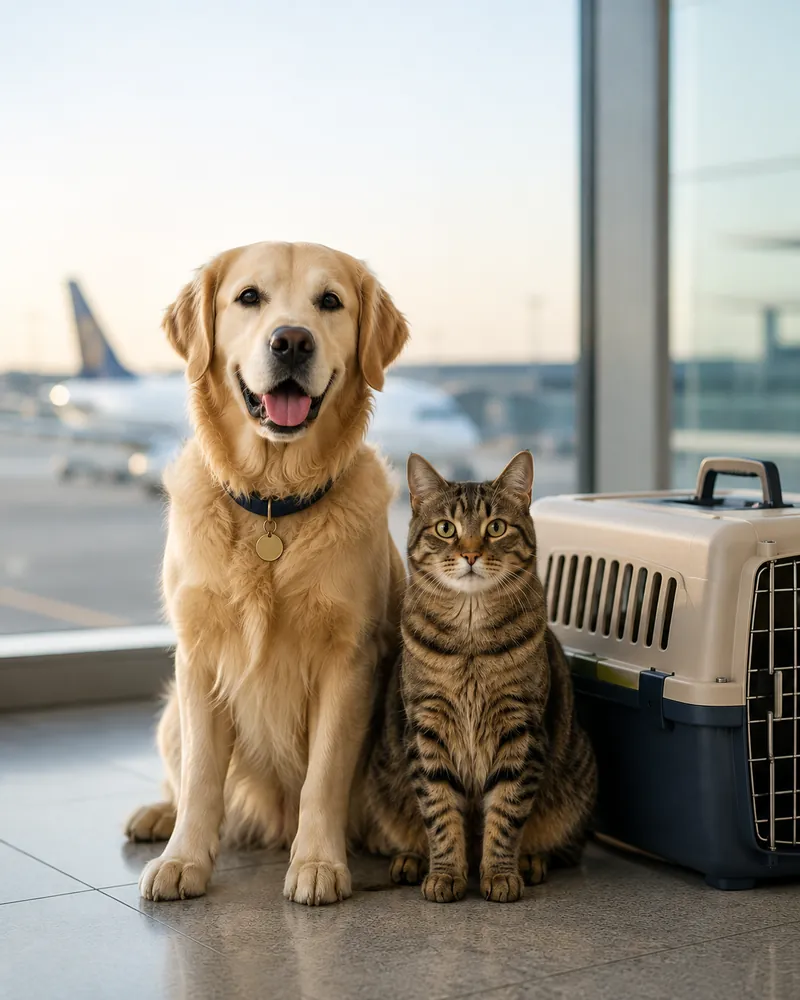
Travelling by air with a dog or cat does not always mean using the same type of transport.
Depending on the airline, the size and weight of the animal, the carrier or kennel, the route and sometimes even the aircraft, a pet may travel either in the passenger cabin (PETC) or in the aircraft hold as accompanied baggage (AVIH).
Understanding the difference between PETC and AVIH is one of the first steps when planning international pet travel.
What does PETC mean?
PETC stands for Pet in Cabin.
The pet travels inside the passenger cabin together with its accompanying traveller, usually inside an airline-approved soft-sided carrier placed under the seat in front. PETC is generally intended for smaller dogs and cats.
Airlines normally impose limits on:
- the combined weight of the pet and carrier;
- the maximum dimensions of the carrier;
- the number of pets allowed in the cabin;
- the number of pets permitted per passenger;
- the routes and aircraft on which PETC is accepted.
These limits vary considerably between airlines. Being small enough to travel in cabin does not automatically mean that a pet will be accepted as PETC on every flight.
What does AVIH mean?
AVIH usually refers to an animal travelling in the aircraft hold as accompanied baggage.
The pet travels on the same journey as an accompanying passenger but remains inside an appropriate rigid kennel during the flight. AVIH is commonly used when a dog or cat exceeds the airline's PETC limits or cannot comfortably travel inside an approved cabin carrier.
The aircraft compartment used for accepted live animals is designed differently from ordinary baggage transport, but acceptance still depends on the airline, aircraft, route, kennel and characteristics of the animal. Not every airline accepts AVIH and not every aircraft can carry animals in the hold.
PETC vs AVIH: what is the difference?
| Consideration | PETC | AVIH |
|---|---|---|
| Where does the pet travel? | Passenger cabin | Aircraft hold |
| Traveller required? | Yes | Normally yes |
| Typical pet size | Small dogs and cats | Medium and larger pets |
| Carrier | Usually a soft-sided cabin carrier | Rigid airline-compliant kennel |
| Weight limits | Usually restrictive | Higher and airline-dependent |
| Access during flight | The pet remains with the passenger but inside the carrier | No access during the flight |
| Airline restrictions | Route, aircraft, size, weight and quota | Route, aircraft, kennel, weight, breed and operational restrictions |
There is no universal PETC or AVIH weight limit. Each airline establishes its own conditions.
How do I know whether my pet should travel as PETC or AVIH?
The decision normally begins with the size and weight of the pet. For PETC, the animal must be able to travel comfortably inside a carrier that complies with the airline's cabin dimensions and conditions. If this is not possible, AVIH may be the appropriate accompanied option, provided the airline accepts the animal and the route allows it.
Other factors can also affect the decision:
- Airline policy. Some airlines offer both PETC and AVIH, others only one, and some do not transport pets on certain routes.
- Aircraft type. An airline may normally accept AVIH but be unable to do so on a particular aircraft.
- Route and connections. A pet accepted on one flight may not necessarily be accepted throughout a connecting itinerary.
- Breed restrictions. Some airlines apply special rules to brachycephalic dogs and cats or to particular breeds.
- Number of pets and travellers. Cabin quotas and passenger limits can make additional accompanying travellers necessary.
Carriers and kennels
What kind of carrier is required for PETC?
PETC normally requires a carrier that fits beneath the passenger seat. Airlines define their own maximum dimensions and may also impose a maximum combined weight for the pet and carrier. The pet must normally remain inside the carrier throughout the flight.
A carrier accepted by one airline should not automatically be assumed to comply with another airline's requirements.
What kind of kennel is required for AVIH?
AVIH normally requires a rigid kennel suitable for air transport. The kennel needs to provide enough space for the animal to stand naturally, turn around and lie down comfortably.
Correct sizing is particularly important. A kennel that is too small may be rejected at check-in even when the pet reservation has already been confirmed. Ventilation, construction, locking system and other requirements must also comply with the operating airline's conditions.
Is AVIH the same as cargo?
No. Although both involve an animal travelling outside the passenger cabin, AVIH and air cargo are different transport arrangements.
With AVIH, the pet normally travels as part of an accompanied passenger journey. Cargo is handled under a separate freight process and may involve different booking procedures, terminals, documentation and handling arrangements.
UniPetrans specialises in accompanied pet travel, including PETC and AVIH solutions where permitted by the airline and route.
What happens when a journey has a connection?
Connecting flights require additional attention. It is not enough to confirm that both individual flights accept pets: the complete itinerary must work as a single journey.
Connection time, airport procedures, airline combinations, terminal changes, local regulations and whether the pet can remain checked through to the final destination can all affect viability. This is one reason why an apparently convenient flight itinerary may not be suitable for travelling with a pet.
Can PETC or AVIH be used internationally?
Yes, but airline acceptance is only one part of an international pet journey. The animal may also require identification by microchip, rabies vaccination, veterinary certificates, import permits or other health and border documentation, depending on the countries involved.
Those requirements are determined by the actual route. For country-to-country information, see the UniPetrans international pet travel route guides.
When can a Pet Nanny help?
Sometimes the owner cannot accompany the pet, or several pets need to travel and the airline requires more accompanying passengers. In these situations, a professional Pet Nanny may accompany the animal during the journey.
Depending on the pet and the airline, the animal may travel with the Pet Nanny either as PETC or AVIH. The objective is not to change the airline's transport rules, but to provide the required accompanying traveller and coordinate the journey from departure to arrival.
Before booking a flight with a pet
Pet acceptance should always be checked for the specific airline, flight, aircraft and date. Airline pet policies can differ between routes and may change over time. Availability can also be limited because airlines normally restrict the number of animals accepted on each flight.
For international travel, airline rules must then be combined with the veterinary and border requirements applicable to the route.