
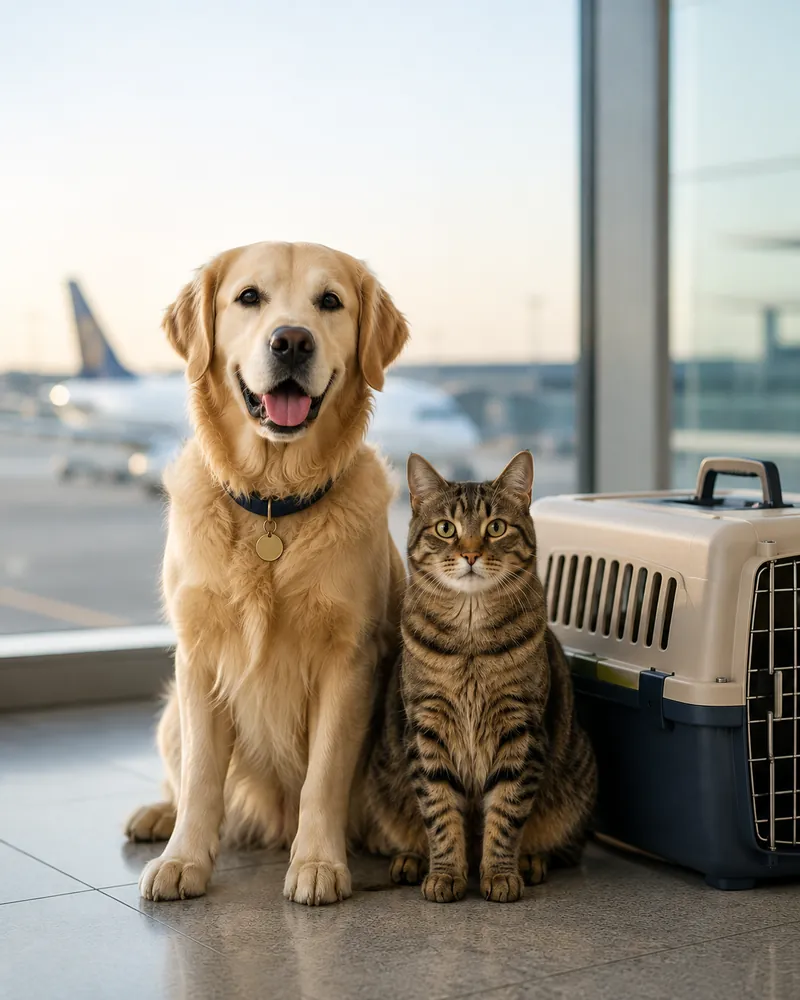
International pet travel involves much more than simply booking a flight.
A successful journey normally requires several elements to work together: the pet's documentation, veterinary requirements, airline acceptance, the correct carrier or kennel, the itinerary and the arrival procedures at the destination.
The exact requirements vary depending on the countries involved, the airline, the animal and the travel dates, but the overall process usually follows a similar structure. Understanding that process early can make international travel with a dog or cat much easier to organise.
1. Start planning early
International pet travel should ideally be planned well before the intended departure date. Some requirements can be completed quickly, while others may depend on vaccination timing, veterinary certificates, laboratory tests, import permits or administrative procedures.
Starting early also gives you more flexibility when choosing flights. Pet-friendly itineraries are often more limited than ordinary passenger itineraries because not every airline, aircraft or connection accepts animals.
Before booking, establish:
- where the pet is travelling from;
- the final destination;
- approximate travel dates;
- the species and breed;
- the pet's weight and measurements;
- whether the owner will travel with the pet;
- whether the pet may qualify for PETC or will require AVIH.
2. Check the destination requirements
Every international journey is governed by the requirements of the country or territory the animal is entering. These may include microchip identification, rabies vaccination, veterinary health certificates, official endorsements, import permits, parasite treatments, laboratory tests, waiting periods and border inspection procedures.
The requirements can differ substantially between destinations and may also depend on where the pet is travelling from. A dog entering one country from Spain may not necessarily follow the same process as a dog entering the same country from another origin.
Route-specific requirements should always be checked before the journey is confirmed.
3. Confirm the microchip
Microchip identification is a fundamental part of many international pet travel systems. The chip provides a permanent link between the animal and its veterinary documentation.
Before travelling, check that the microchip can be read correctly, the recorded number is accurate and it is consistent across veterinary records and certificates.
The order in which identification, vaccination and other veterinary procedures take place can matter. Documentation should be reviewed as a complete sequence rather than as independent documents.
4. Check the rabies vaccination
Rabies vaccination is one of the most common requirements in international pet travel. However, having a vaccination recorded does not automatically mean every destination requirement has been satisfied.
Authorities may apply rules concerning the animal's age, vaccination date, relationship between the microchip and vaccination, validity, waiting periods and additional blood testing. Always verify the conditions applicable to the actual route.
5. Determine whether additional veterinary procedures are required
Some journeys require more than microchip identification and rabies vaccination. Depending on destination and origin, the process may involve health examinations, laboratory testing, parasite treatment or official certification.
The timing can be important. A document completed too early or too late may not be valid for entry, so work backwards from the intended travel date when organising the veterinary process.
6. Decide how the pet will travel
Once the basic documentation requirements are understood, determine how the animal can travel on the aircraft.
PETC — Pet in Cabin
Smaller dogs and cats may be permitted to travel in the passenger cabin inside an airline-approved carrier. The airline normally establishes limits on dimensions, weight and the number of pets accepted.
AVIH — Pet in the Hold
Larger animals may travel in the aircraft hold as accompanied baggage, inside a suitable rigid kennel. Acceptance depends on the airline, aircraft, route, kennel and characteristics of the animal.
If you are unsure which method applies, see our PETC vs AVIH guide.
7. Measure the pet before choosing the carrier or kennel
The animal's measurements should be known before choosing transport equipment or finalising certain itineraries. For PETC, the pet must fit comfortably inside a carrier that complies with the airline's cabin dimensions.
For AVIH, the animal normally needs a rigid kennel with enough space to stand naturally, turn around and lie down comfortably. For larger dogs in particular, kennel size can affect which aircraft or routes are possible.
Our airline kennel measurement guide explains this process in more detail.
8. Choose the itinerary carefully
The shortest passenger itinerary is not always the best pet itinerary. When animals are involved, the route needs to be assessed as a complete journey.
Important factors include airline and aircraft acceptance, flight duration, connection times, airport transit procedures, temperature or seasonal restrictions, through-checking, different operating airlines and destination entry procedures.
A connection that is perfectly reasonable for a passenger may not be viable for a pet.
9. Confirm pet acceptance before relying on the booking
A passenger ticket and a pet reservation are not the same thing. Pet acceptance should be confirmed according to the airline's procedure before relying on an itinerary.
Airlines may limit the number of animals accepted on a flight, and restrictions can depend on the route or aircraft. For AVIH, kennel dimensions and weight may form part of the acceptance process.
Buying the passenger ticket does not automatically guarantee that the animal can travel.
10. Prepare the carrier or kennel
The transport container should be prepared well before departure. For cabin travel, check the operating airline's permitted carrier dimensions and conditions.
For AVIH, check kennel size, structural condition, ventilation, door security, fasteners, water provision and any airline-specific requirements.
Avoid leaving kennel selection until the final days. If the proposed kennel is rejected, finding a suitable replacement at short notice may be difficult.
11. Help the pet become familiar with the carrier
Preparing the animal is part of preparing the journey. Whenever possible, allow the dog or cat time to become accustomed to the carrier or kennel before the flight.
A gradual introduction can make the container a familiar environment rather than something associated only with the airport. For longer journeys, this preparation can be particularly useful.
12. Prepare the travel documentation
Organise the pet's documentation so it is easy to access. Depending on the route, this may include identification and vaccination records, veterinary certificates, laboratory results, permits, official endorsements and destination-specific forms.
Check that names, microchip numbers, dates and other important details are consistent. Small documentary errors can create disproportionate problems during international travel.
13. Prepare for the airport
Travelling with a pet normally requires more time at the airport than an ordinary passenger journey. Arriving early allows time for check-in, document checks, kennel inspection, pet fees and operational procedures relating to the animal.
The precise process varies by airline and airport. For AVIH journeys, the animal may need to be delivered through a specific check-in or handling process.
14. Food, water and exercise before departure
Preparation immediately before the flight should prioritise the animal's comfort and normal routine. Dogs should normally have an opportunity to exercise and relieve themselves before entering the kennel.
Food and water arrangements depend on journey length, veterinary advice and airline requirements. For longer itineraries, plan these details in advance rather than deciding at the airport.
15. What happens during the flight?
For PETC, the animal normally remains inside its carrier in the passenger cabin throughout the flight. For AVIH, the pet travels in an appropriate aircraft compartment and is not accessible to the passenger during the flight.
The exact procedures depend on the airline and aircraft. This is another reason why airline selection is an important part of pet travel planning.
16. Connections require special attention
If the itinerary includes a connection, clarify whether the pet is checked through, whether the connection airport permits the transfer, whether the connection time is sufficient, whether a terminal change is involved, whether both airlines accept the pet and whether the animal must be collected and checked in again.
Connecting journeys should never be assessed solely by looking at the passenger itinerary.
17. Prepare for arrival
The journey does not necessarily finish when the aircraft lands. Arrival may involve immigration or customs procedures, veterinary inspection, document checks, collection from a designated area, local fees and onward transport.
The owner or accompanying traveller should know in advance where the animal will be collected and what procedures are expected.
18. Consider the complete journey, not only the flight
International pet travel is a chain of dependent steps. A journey can only work when the documentation, animal, transport container, airline and itinerary are compatible with one another.
Changing one element can affect the whole plan. Changing airline may alter permitted kennel dimensions, while changing the travel date may affect documentation validity or pet availability on the flight.
The safest approach is to plan the journey as a complete system rather than booking each element independently.
When can a Pet Nanny help?
Not every owner can travel with their pet. In other cases, several pets may need to travel and airline rules may require additional accompanying passengers.
A professional Pet Nanny can accompany the animal and coordinate the travel process. Depending on the pet and itinerary, it may travel with the Pet Nanny as PETC or AVIH.
The documentation and import requirements remain those applicable to the individual pet and route.